filtri
No filter selected
Whole range of 35 Petrol Rough Cut Mowers Eurosystems models, offered for sale from € 1,093.56 , in Prompt Delivery and Free shipping . Purchase directly from AgriEuro with no third parties nor unwanted surpreses: compared to the other online markets, who rely on third dealers (it means no assistance nor warranty), we offer Direct and Complete Assistance, which starts from pre-sales service up to after-sales assistance. The items are directly shipped from our AgriEuro distribution centre. Thus, we are the only online seller providing After-Sales Assistance for the Petrol Rough Cut Mowers Eurosystems products and supplying Spare Parts (you access the exploded drawing once entered your Account).













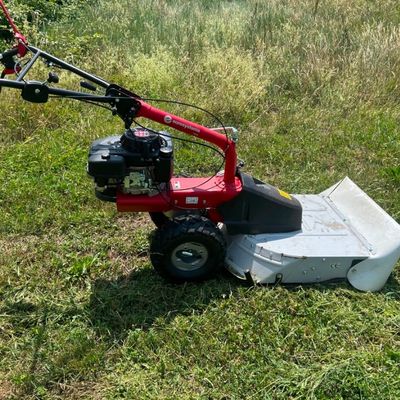
Eurosystems petrol brush mowers are designed to cut and shred tall grass, spontaneous vegetation, thick weeds, reeds and small plant debris. They are suitable for the periodic clearance of uncultivated land, vegetable gardens, orchards and rural surfaces where a conventional lawn mower would be unsuitable. The petrol engine allows the machine to work away from electrical outlets, with an operating capacity suitable for extended jobs. The drive system and treaded wheels fitted to selected models support forward movement over uneven or slightly sloping ground.
Eurosystems was established in 1973 in Luzzara, in the province of Reggio Emilia, an area closely associated with working the land. Over time, the brand expanded its range with machines for gardening, horticulture and agriculture, retaining its production processes in Italy and bringing operations such as painting and welding in-house. Since the 1980s, it has also developed dedicated products for international brands. The multi-tool range reflects this evolution: one power unit can accommodate different attachments, reducing storage space and concentrating routine maintenance on a single engine.
At AgriEuro, products can be selected according to their technical features, helping identify the Eurosystems petrol brush mower best suited to the surface, vegetation and frequency of work. Comparing the model specifications makes it possible to assess the following elements:
Hobby and semi-professional operating levels should be chosen according to the size of the surface and the frequency of the work. Occasional work on a small plot requires different specifications from the regular clearance of an orchard or an area with dense vegetation. Each model page lists the specific equipment and capabilities to compare with the intended task.
Eurosystems blade petrol brush mowers feature a cutting deck designed to shred vegetation and leave finer debris on the ground than simple mowing. The self-propelled structure supports forward movement over surfaces with tall grass and ground that is not perfectly even. The multi-tool configuration also allows the same power unit to perform different tasks using compatible attachments sold separately.
When working through dense vegetation, the travel speed must be matched to the height of the grass and the consistency of the material. Moving at a suitable pace allows the deck to complete the shredding process without subjecting the engine to excessive loads. Stones, metal objects, stumps and other foreign bodies must be removed before each pass, as they could damage the cutting system or be thrown outwards. Cutting-height adjustment, where available, helps keep the blade away from more pronounced irregularities. Models with belt transmission and a separate deck engagement system allow the cutting unit to be stopped during transfers. After work, removing debris from the housing and checking the blades, guards and belts prepares the machine for its next session.
Purchasing a Eurosystems petrol brush mower from AgriEuro provides access to detailed technical specifications and makes it easier to compare the available configurations. After ordering, dedicated services support the machine throughout delivery, maintenance and after-sales assistance:
Buy the Eurosystems petrol brush mower best suited to the intended work now and choose the configuration available from AgriEuro.
It is used to cut and shred tall grass, spontaneous vegetation, thick weeds and small plant debris on surfaces requiring more intensive work than a conventional lawn mower can provide. It can be used to clear uncultivated land, orchards, field boundaries and rural surfaces. The petrol engine makes the machine independent of the electricity supply; the drive system, where fitted, supports forward movement. Cutting limits, permitted gradients and suitable materials always depend on the model and must be checked in the relevant technical specifications and manual.
A brush mower works through tall, untidy vegetation, shredding it and leaving the material on the ground; a lawn mower maintains an already cared-for lawn at a uniform height. Their cutting systems, construction and travel speeds therefore serve different purposes. A brush mower is suitable for less frequent work on dense grass, weeds and uneven ground. A lawn mower is better suited to the regular cutting of level lawns. The choice should be based on the condition of the vegetation and the required result, not only on the size of the surface.
The choice requires a comparison of the size of the plot, height and density of the vegetation, unevenness of the ground and frequency of work. The engine and gearbox ratios should be appropriate for the expected load. Cutting width affects productivity and the space required for manoeuvring. Drive, reverse gear, wheel size and handlebar adjustments influence machine control. For a multi-tool power unit, the exact compatibility of the attachments must also be checked. Weight, permitted gradient and the limits declared by the manufacturer complete the comparison.
It can operate only within the maximum gradient specified by the manufacturer and when the ground, grip and stability allow it. Drive and treaded wheels assist forward movement but do not make every slope safe. The model manual must be consulted, and ditches, embankments and soft or wet ground should be avoided. The direction of travel must comply with the instructions. Work must be stopped if the machine loses traction or requires continuous corrections. Obstacles and changes in gradient increase the risk and require the surface to be assessed beforehand.
It is preferable to work with dry vegetation and firm ground. Wet grass tends to accumulate inside the housing, can reduce shredding quality and increases the load on the cutting components. Damp ground can also reduce wheel grip, creating greater difficulty on slopes. If the model instructions permit the work, travel speed should be reduced and accumulations checked more frequently, always with the engine switched off and all parts stationary. Work should be postponed in the presence of mud, standing water or loss of stability.
Before starting the engine, it is necessary to inspect the surface and check the condition of the machine. Stones, metal wires, stumps, plastic and other foreign bodies must be removed from the route. The oil level, fuel, air filter, fasteners, guards, blade or knives and belt condition must be checked as specified in the manual. The controls, drive and stopping devices must also operate correctly. The operator must wear the prescribed protective equipment and keep people and animals at the distance specified by the manufacturer.
The engine requires periodic checks of the oil, air filter, spark plug, fuel and cooling system. Intervals, lubricant and procedures vary according to the engine installed, so the machine and engine manuals must always be followed. Dust and debris should be removed from the specified areas after work, without touching hot components. Fuel must be stored in suitable containers and should not be allowed to deteriorate inside the system. Before cleaning or maintenance, the engine must be switched off, cool and secured as instructed.
The blades should be checked before every session and after any impact. An uneven cut, abnormal vibrations, unusual noises or increased engine strain may indicate wear, deformation, looseness or imbalance. In these cases, the machine must be stopped and inspected. Sharpening, balancing and replacement require suitable tools and skills; if they are not listed among the operations permitted for the user, they must be entrusted to the service department. The machine must not be operated with damaged blades or incomplete guards, as this increases the risk of breakage and thrown objects.
The most common causes are worn or unbalanced blades, a damaged belt, debris inside the deck or an excessively high travel speed for the height of the vegetation. The machine must be stopped immediately if vibrations become abnormal, the cutting system disengaged and the safety procedure in the manual followed. Once the machine has cooled, only checks authorised for the operator may be carried out. If the problem persists, the service department must be contacted. Continuing to work may extend the damage to the transmission, supports and cutting components.
A multi-tool system uses a motorised power unit to which compatible attachments are connected for different jobs. The brush mower deck is used for cutting and shredding; other attachments can adapt the power unit to tasks such as soil cultivation, mowing or sweeping, depending on the declared compatibility. This solution reduces the number of engines requiring maintenance and the space occupied during storage. Before purchasing, it is necessary to check the model, coupling, required equipment and assembly procedure. Attachments that are not expressly compatible must not be installed.
To change language, please click on the following abbreviations: