filtri
No filter selected
Whole range of 9 Garden Tillers EuroMech models, offered for sale from € 546.43 , in Prompt Delivery and Free shipping . Purchase directly from AgriEuro with no third parties nor unwanted surpreses: compared to the other online markets, who rely on third dealers (it means no assistance nor warranty), we offer Direct and Complete Assistance, which starts from pre-sales service up to after-sales assistance. The items are directly shipped from our AgriEuro distribution centre. Thus, we are the only online seller providing After-Sales Assistance for the Garden Tillers EuroMech products and supplying Spare Parts (you access the exploded drawing once entered your Account).













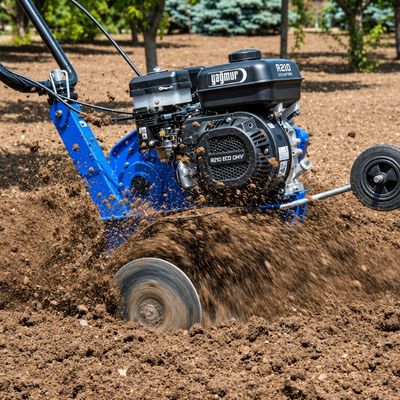
EuroMech rotary tillers are designed to prepare vegetable gardens, gardens and small plots by tilling and breaking up clods. EuroMech is an AgriEuro Srl brand involved in the development, import and distribution of equipment designed for the European market. The progressive expansion of the range has led the brand to offer machines for different working environments, aimed at both private users and those requiring greater working continuity. The administrative offices are located in Petrognano, near Spoleto, where the central workshop for repairs and after-sales service is also based.
These machines can break the surface crust, crumble clods and mix the soil before sowing or transplanting. They can be used to prepare seasonal vegetable gardens, refine the soil between one crop and the next or incorporate soil conditioners that have already been spread. The petrol engine allows work to be carried out without a connection to the mains, even on plots far from buildings.
This page also includes the following type of EuroMech machine, designed for mechanical soil cultivation:
At AgriEuro, EuroMech rotary tillers can be selected according to their main technical features, making it easier to find a machine suited to the available surface, soil consistency and frequency of work. Before choosing, it is useful to compare the following elements:
The range is intended mainly for domestic work, including continuous tasks in home vegetable gardens, flower beds and small plots that have already been broken up. The choice should also consider the presence of stones, roots and plant debris, which must be removed before tilling whenever they could obstruct the rotating components.
The choice of machine depends on the size of the plot and the required degree of soil refinement. The soil type determines the depth of each pass and the load placed on the tilling unit. Working width, transmission and transport equipment also affect operating practicality.
EuroMech petrol rotary tillers are suitable for tilling vegetable gardens, gardens and previously cultivated soil without depending on an electrical socket. The range includes configurations with four-stroke engines of different origins and power ratings, combined with tilling units intended for different surfaces and soil textures. The rotation of the blades breaks the crust, reduces clods and mixes the surface layer. Some models allow the tilling width to be changed by removing the outer elements, making it possible to move from open spaces to areas close to rows and fences. Depending on the model, the transmission may combine a belt and an oil-bath chain. The adjustable rear drag stake helps control penetration and forward speed. Side discs, guards, adjustable handlebars and a front transport wheel complete the available equipment, which must always be checked in the individual technical specifications.
Before purchasing, the following aspects should be compared in particular:
Buying a EuroMech rotary tiller from AgriEuro provides access to dedicated services even after delivery. The availability of technical information, spare parts and specialist support accompanies the machine throughout its working life.
Buy the EuroMech rotary tiller best suited to the soil now and prepare the vegetable garden with a machine selected according to actual operating requirements.
The choice should start with the surface, soil consistency and width of the spaces to be cultivated. For a vegetable garden that has already been broken up, a domestic machine with a simple transmission may be suitable; for more frequent work, weight, displacement and the strength of the tilling unit become more important. A wide tiller reduces the number of passes on open surfaces but may be less practical between rows and borders. The option of reducing the tilling width should also be checked, together with the presence of transport wheels, adjustable handlebars, side discs and reverse gear. The information in each product’s technical specifications should always take precedence over general guidance.
EuroMech petrol rotary tillers are intended mainly for vegetable gardens, gardens and previously cultivated soil with characteristics compatible with the chosen model. Medium-textured soil can be worked with several progressive passes, beginning at a limited depth. Large stones, thick roots, stumps and foreign objects must be removed before starting. Soil that has never been cultivated, is very compact or contains many obstacles may require a heavier machine or preliminary preparation. The soil classification shown on the product page helps prevent the machine from being used beyond its intended capacity.
A wide working width is suitable for open plots because it covers a larger strip with each pass. A narrower tiller provides more precise control between rows, flower beds, trees and fences. Some EuroMech rotary tillers allow the width to be adjusted by removing some of the outer blades. This solution makes it possible to adapt the same machine to differently shaped spaces. Before purchasing, the standard and reduced working widths stated in the technical specifications should be compared, checking that both are compatible with access points and the spacing between crops.
The rear drag stake provides resistance to the forward movement generated by the tines and helps regulate penetration into the soil. A deeper adjustment slows the machine and supports the action of the blades; a less pronounced position facilitates a shallow pass. The side discs define the worked strip, reduce the outward displacement of soil and protect nearby crops. Both must be adjusted or installed according to the instructions for the specific model. Any work on the tines must be carried out with the engine switched off and cold and the spark plug disconnected.
Very hard soil requires gradual, shallow passes without forcing the machine through in a single operation. If the soil has never been broken up, preliminary preparation or equipment from a higher category may be required. Tilling very wet soil is not recommended: soil sticks to the blades, increases rotational resistance and forms compact clods. Work should be postponed until the soil reaches a moisture level suitable for crumbling. Where tall grass is present, plant debris must be cut and removed to prevent it from wrapping around the rotating components.
Reverse gear is not essential for every task, but it is useful on heavier machines and in confined spaces. It makes leaving a furrow, changing direction and moving away from fences or the ends of the vegetable garden easier. Single-speed models have a simpler control layout and are suitable for straight paths on surfaces without many obstacles. The availability of reverse gear must be checked in the specifications of the individual EuroMech rotary tiller. During manoeuvres, the procedure indicated by the manufacturer must be followed and a safe distance from the tines must always be maintained.
Before starting, check the engine oil, transmission lubrication, tine assembly and integrity of the guards. Some machines may be supplied with transmission components without oil, so the manual and product specifications must be read before starting the engine. The tightness of the bolts, drag stake position, handle controls and side disc assembly must also be checked. The fuel must be fresh and comply with the manufacturer’s instructions. Starting the machine without the required fluids may cause mechanical damage unrelated to product defects.
Routine maintenance includes checking the oil, cleaning the air filter, inspecting the spark plug and examining the tines. After work, soil, grass and debris should be removed only when the engine is switched off and cold. The blades must be checked for looseness, deformation or breakage; damaged components require compatible spare parts. The transmission, belts and control linkages must also be inspected according to the intervals indicated in the manual. Lubricant types and maintenance frequencies differ between models, so general intervals should not replace the official instructions.
Before a period of inactivity, the rotary tiller must be cleaned, dried and checked. Soil should be removed from the tines and guard without directing water jets towards the air filter, exhaust or sensitive components. The procedure for petrol and the carburettor depends on the engine and the length of storage: the specific manual must be followed, avoiding solutions applied indiscriminately to every model. The machine must be stored in a stable position in a dry place protected from the weather. Folding handlebars can reduce its overall dimensions, provided they are secured in the configuration specified by the manufacturer.
A rotary tiller advances through the rotation of its tines and is designed mainly to break up and mix the soil. A two-wheel tractor has driven wheels, a gearbox and a coupling for different implements, depending on its configuration. A rotary tiller is suitable when the main task involves periodically preparing a vegetable garden or finishing a seedbed. A two-wheel tractor is more suitable for larger surfaces, demanding soil and tasks requiring implements other than a tiller. The decision should therefore consider not only power but also the work planned throughout the year.
To change language, please click on the following abbreviations: