filtri
No filter selected
Our range 2026 of Eschenfelder with 14 models available and offered for sale from € 12.90 , in Prompt Delivery and Free shipping. Purchase directly from AgriEuro with no third parties nor unwanted surpreses: compared to the other online markets, who rely on third dealers (it means no assistance nor warranty), we offer Direct and Complete Assistance, which starts from pre-sales service up to after-sales assistance. The items are directly shipped from our AgriEuro distribution centre. Thus, we are the only online seller providing After-Sales Assistance for the Eschenfelder products and supplying Spare Parts (you access the exploded drawing once entered your Account).


Eschenfelder was founded in 1988 by Frank Eschenfelder, a machine fitter and electrical engineer from Kaiserslautern. After seeing a handcrafted grain flaker built by his friend Christian Kuhtz, Frank developed a domestic appliance for preparing fresh flakes every day. The first model reached series production after numerous tests conducted in his parents’ garage, with support from the Lebenshilfe workshop in Bad Dürkheim.
In 1991, the business moved to Hauenstein in the Palatinate, and production was transferred to the company’s current premises in 2004. Family continuity has preserved the original approach: handcrafted production, construction precision and careful material selection. The grain flakers are still manufactured in Hauenstein, with stainless steel rollers and solid wood frames. The result combines functionality, mechanical simplicity and an appearance suited to domestic kitchens.
The AgriEuro range includes Eschenfelder manual grain flakers designed to process small quantities of cereals, oilseeds and other compatible ingredients. They are suitable for breakfasts, muesli, doughs and recipes where the grain is processed shortly before consumption. The open construction makes it easier to monitor the process and perform routine maintenance.
Tabletop models are secured to the worktop with a clamp; wall-mounted versions leave the work surface clear. This choice makes it possible to consider the available space, preparation frequency and the most suitable position in the kitchen.
At AgriEuro, Eschenfelder grain flakers can be selected according to their installation type, hopper material and individual technical specifications. The two stainless steel rollers operate without gears and allow continuous adjustment of flake thickness. The models documented by the manufacturer process approximately 50 grams in 20 seconds and handle cereals other than maize, as well as various oilseeds, spices and small legumes.
The crank provides direct manual operation, suitable for domestic portions and frequent preparation. The flakes can be used for muesli, porridge, biscuits, bread and custom mixtures. The open construction provides easy access to the rollers for cleaning with a brush, without dismantling the machine.
AgriEuro complements its selection of Eschenfelder grain flakers with services dedicated to delivery, maintenance and after-sales support. The availability of technical information and spare parts helps customers look after the product even after purchase.
Discover the Eschenfelder grain flakers available at AgriEuro and compare the different configurations. Purchase the model best suited to the available space and intended preparations.
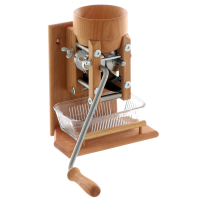
An Eschenfelder grain flaker is a manual appliance that compresses grains between two stainless steel rollers, turning them into flakes. The cereal is poured into the hopper and the crank rotates the crushing system. The processed ingredient then drops into the container placed beneath the chute. The mechanism requires neither electricity nor a gear system. The roller pressure can be adjusted to change the thickness and adapt the result to muesli, porridge, baked goods and other homemade recipes.
Eschenfelder grain flakers process the main cereal varieties, excluding maize. Suitable ingredients include oats, wheat, spelt, rye, barley, rice, millet and buckwheat, provided their dimensions are compatible with the hopper and rollers. Their behaviour varies according to the hardness, moisture content and fat content of the grain. It is therefore advisable to begin with a small quantity and adjust the thickness gradually. The instructions for the individual model remain the main reference for less common ingredients or particular preparations.
No, the manufacturer excludes maize from the ingredients suitable for Eschenfelder grain flakers. Its hardness and grain size fall outside the intended operating range of these manual appliances. Forcing an unsuitable ingredient through the rollers can produce uneven results and subject the mechanism to improper stress. Maize requires a machine specifically designed for this cereal. Before processing particularly hard or unusually sized grains, the instructions for the individual model should always be checked.
Yes, the stainless steel rollers can also process various oilseeds, spices and small legumes. The manufacturer mentions flaxseed, sesame, poppy seeds, sunflower seeds, fennel, caraway, coriander and lentils, among other ingredients. Some oil-rich ingredients may leave deposits on the rollers, so thorough cleaning after processing is advisable. Chopped nuts, dried herbs and small pieces of dried fruit can be added to mixtures in moderate quantities and in accordance with the instructions in the manual.
The thickness is changed through the continuous adjustment of the distance between the rollers. A smaller gap produces a thinner flake; a larger gap leaves a more substantial texture. Adjustments should be made in small increments, testing a few grains and checking their consistency and uniformity. Different cereals may require different settings, so there is no single position suitable for every ingredient. If the grain does not flow regularly or the crank becomes too difficult to turn, processing should be stopped to check the adjustment, cleanliness and suitability of the ingredient.
For the models described by the manufacturer, a portion of approximately 50 grams takes around 20 seconds. The actual time varies according to the cereal, roller setting and continuity of crank rotation. This output is suitable for immediately preparing a portion of muesli or porridge and makes it possible to process only the required amount. Harder ingredients, mixtures or very fine settings may require a slower pace. Steady rotation encourages uniform flakes and reduces build-up in the hopper.
The choice depends on the available space and intended position. A tabletop model is secured to the edge of a worktop with a clamp and can be removed after preparation. It is suitable when the machine needs to be stored away or moved between different surfaces. A wall-mounted model remains in a fixed position and leaves the kitchen worktop free, but requires a dedicated installation point. Before purchasing, check the worktop thickness, edge depth or wall characteristics according to the selected fastening system.
The tabletop model must be attached to a stable worktop using the screw clamp. In the documented configurations, the clamp accommodates worktops up to 4.5 cm thick and requires an edge at least 3 cm deep. The screw should be tightened sufficiently to prevent movement during rotation without damaging the surface. Before filling the hopper, check the stability of the machine and, on models with a removable wooden hopper, its correct positioning. A firm base makes the crank smoother and keeps the collection container aligned with the chute.
Routine cleaning is carried out with a small, soft brush, using the open construction to remove flour and fragments from the rollers. After processing oilseeds or spices, the manufacturer recommends passing a small quantity of rice through the machine to collect some of the residue. If necessary, the rollers can then be cleaned with a brush and a slightly damp cloth. Abrasive products must not be used; the machine must not be immersed, placed in a dishwasher or dismantled. Wooden parts must not remain in contact with water for extended periods.
Maintenance mainly consists of regular residue removal, checking the fastening system and inspecting the roller adjustment. After processing oily ingredients, the crushing surfaces should be cleaned promptly to prevent deposits from hardening. The scraper blades must not be bent during cleaning and the roller assembly must not be dismantled. The frame can be wiped with a barely damp cloth and then dried. If unusual friction, mechanical play or damaged components are noticed, processing should be stopped and the manual or technical support consulted.
To change language, please click on the following abbreviations: