filtri
No filter selected
Our range 2026 of Deca with 84 models available and offered for sale from € 9.86 , in Prompt Delivery and Free shipping. Purchase directly from AgriEuro with no third parties nor unwanted surpreses: compared to the other online markets, who rely on third dealers (it means no assistance nor warranty), we offer Direct and Complete Assistance, which starts from pre-sales service up to after-sales assistance. The items are directly shipped from our AgriEuro distribution centre. Thus, we are the only online seller providing After-Sales Assistance for the Deca products and supplying Spare Parts (you access the exploded drawing once entered your Account).


For over 50 years, Deca has been designing and manufacturing battery charging and welding equipment. The company is based in Falciano, in the Republic of San Marino, and directly oversees concept development, design, industrialisation, production and quality control. Its range has expanded to meet the needs of DIY users, maintenance technicians, workshop technicians and professionals, with solutions for metalworking, battery care and vehicle starting.
The catalogue brings together equipment for a wide variety of jobs: from repairing a fence and welding workshop components to charging the batteries of cars, motorcycles and work vehicles. The choice can therefore be based on the actual application, frequency of use and required performance. Build reliability, technical development and a broad product range characterise the Deca welding and charging range.
This page also includes the following Deca product types, helping users quickly identify the equipment that best suits the job:
At AgriEuro, Deca products can be selected according to their technical characteristics, making it easier to identify the model best suited to each requirement. When comparing devices intended for different functions, it is useful to assess the parameters that affect the type of work, compatibility and operating continuity:
Models for DIY use are suitable for occasional garage maintenance and small household repairs. Semi-professional solutions support more frequent work on vehicles or metal structures; professional units offer configurations suitable for workshops and continuous operations, always within the stated duty-cycle values.
The Deca range available at AgriEuro includes devices for battery charging and vehicle starting, as well as machines designed for metal welding. The two families cover different jobs, but both focus on parameter adjustment and the selection of the correct performance level. Comparing the specifications makes it possible to move from a practical requirement to a model suited to the vehicle, material, thickness and frequency of use.
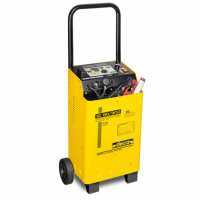
Deca battery chargers and jump starters include compact devices, multifunction units and workshop models. The selection varies according to rated voltage, charging current, supported battery capacity and the current supplied during starting assistance. Before choosing, it is important to distinguish progressive charging from maintenance charging and the start function: a battery charger restores energy over time; a maintainer preserves the charge level during extended periods of inactivity; a jump starter supplies high current to start a vehicle. Electronic models may include programs for different battery technologies, system tests, diagnostic functions and power-supply modes. Traditional and wheeled versions meet the needs of workshops, vehicle fleets and agricultural machinery, with higher current and capacity values. Portable models are suitable for cars, motorcycles, vans and emergency operations, in accordance with the compatibility information stated in the technical specifications.
The following elements are useful when comparing the available configurations:
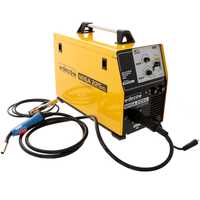
Deca welding machines include inverter models for MMA, MIG/MAG and TIG Lift processes, as well as multi-process configurations. Electrode welders are practical for maintenance, repairs and outdoor work; wire welders support continuous weld beads and more consistent output on metal structures and sheet metal. Multi-process versions allow operators to switch between several techniques using compatible accessories, shielding gases and consumables. The choice depends on the metal, thickness, electrode or wire diameter and the current required for the joint. The duty cycle also deserves attention, as it states how long the machine can weld within a defined period before cooling is required. Functions such as Hot Start, Arc Force and Anti-Stick assist arc striking, arc stability and electrode release. Power supply, adjustment range, wire feeder and torch equipment are also important for workshops and metalworking businesses.
The selection can be refined by considering the following parameters:
Buying a Deca product from AgriEuro provides access to organised services both before and after delivery. Logistics, spare parts and technical support remain available after the order has been placed:
Choose the Deca product suited to your work and buy it now from AgriEuro.
The choice depends on the required operation. A battery charger gradually restores energy to a discharged battery; a maintainer monitors and preserves the charge during long periods of inactivity; a jump starter supplies high current to start a vehicle. Some models combine several functions, but voltage, battery technology and Ah capacity must always be compatible. Automatic maintenance charging may be useful for cars or machines that remain unused for long periods. In a workshop, a start function can support work on several vehicles. Both the device manual and the vehicle manual must be checked before connection.
The current must be selected according to the battery capacity expressed in Ah and the manufacturer's instructions. A value that is too low increases charging time; an unsuitable value may place the battery under stress or activate safety systems. Automatic battery chargers adjust the stages according to the selected program, but voltage and battery technology must be set correctly. Compatibility with AGM, GEL, conventional or traction batteries must not be assumed: it must be stated in the model specifications. Temperature, battery condition and discharge level may also affect the cycle. A damaged battery or one that cannot retain its charge requires technical inspection.
No. Support for 12/24 V does not automatically make the device suitable for every vehicle. Battery capacity and technology, the required current, the selected mode and the vehicle instructions must all be checked. Cars and motorcycles often use 12 V systems; some commercial, agricultural or industrial vehicles may use 24 V systems. The selector or program must match the actual rated voltage. On vehicles with sensitive electronics, the connection points specified by the manufacturer must also be observed. Incorrect connections or settings may damage the battery, the device or the electrical system.
The connection must follow the sequence specified in the device and vehicle manuals. As a general rule, with the device switched off or disconnected from the mains, the red clamp is connected to the positive terminal first, followed by the black clamp at the specified negative connection point. On some vehicles, the manufacturer identifies a separate earthing point away from the battery. Before powering the device, check the voltage, polarity, clamp stability and condition of the cables. Disconnection must follow the sequence stated in the manual. The operation should be performed in a ventilated environment, away from flames and sparks, while wearing the specified protective equipment.
A jump starter with voltage and peak current compatible with the vehicle is required. Diesel engines and larger engine capacities often require higher currents than small petrol engines, but the correct value must be checked in the vehicle instructions and jump-starter specifications. External temperature, battery condition and the permitted number of starting attempts must also be considered. A high rated value does not replace the correct procedure and does not make the device suitable for every electrical system. If the battery is faulty, internally disconnected or severely deteriorated, the jump starter may not solve the problem and a diagnostic check may be required.
The difference concerns the process, consumable and weld-pool protection. MMA uses a coated electrode and is suitable for maintenance, metalwork and outdoor jobs. MIG/MAG continuously feeds wire through the torch and, in the appropriate configurations, uses shielding gas; flux-cored wire allows certain jobs to be completed without a gas cylinder. TIG uses a tungsten electrode and provides accurate control on joints and thin materials, but requires more preparation. A multi-process machine combines several modes, provided that the correct torches, gas, polarity and consumables are available.
Beginners should choose a machine suited to their most frequent jobs and the available electrical supply. A compact MMA inverter welding machine can be suitable for iron repairs and light metalwork because it requires relatively simple equipment. Users who often work on sheet metal can consider a wire welder, paying attention to the gas, wire, wire feeder and adjustment options. Hot Start, Arc Force and Anti-Stick functions can assist arc striking and reduce electrode sticking. Before the first tests, the manual must be read, suitable protective equipment must be worn and the surfaces, earth connection and consumables must be prepared correctly.
Amperage depends on the process, material, thickness, joint and consumable. In MMA welding, the electrode type and diameter are important; in wire processes, wire diameter, feed speed, voltage and gas must also be considered. Insufficient current can produce an unstable arc or inadequate penetration; excessive current can increase spatter, distortion or the risk of burn-through. There is therefore no single value suitable for every job. The consumable manufacturer's tables and welding-machine manual provide a starting point. A test on scrap material can then be used to refine the setting before welding the final joint.
The duty cycle indicates the proportion of a reference period during which the welding machine can operate at the stated current before a cooling pause is required. For example, a 60% duty cycle over ten minutes corresponds to six minutes of operation and four minutes of rest under the specified test conditions. The value must be considered together with the reference temperature and amperage because it changes as the current changes. A limited duty cycle may be sufficient for short, occasional jobs. Long weld beads and repeated operations require values suited to the expected continuity without exceeding the machine's limits.
These are assistance functions commonly used in MMA welding. Hot Start briefly increases the current during arc striking, helping to ignite the arc. Arc Force dynamically changes the current when the arc shortens, helping to keep it stable. Anti-Stick reduces the current if the electrode sticks to the workpiece, making it easier to release and limiting overheating. The presence and possible adjustment of these functions depend on the Deca model. They do not replace the correct choice of electrode, polarity and amperage, nor the proper preparation of the joint and earth clamp.
To change language, please click on the following abbreviations: